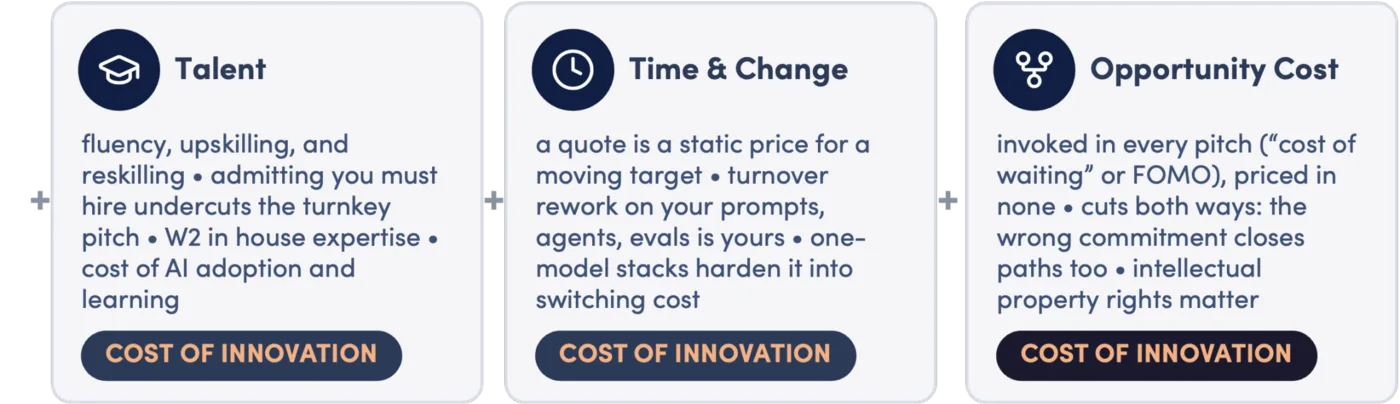


In my first in this series, I walked through the ten dimensions of AI costs. I ran out of time to talk through the hardest cost of all - the cost of innovation. The cost of innovation, never factored into the proposal... The investment in (and struggle to develop) talent. The time innovation takes. The cost of change. The tradeoffs we make when we decide to do a thing, and not do some other thing. I don't know what to call these things except "the cost of innovation". In my own journey at PhoenixTeam, we've paid a heavy cost to innovate. I suspect we are not alone. That cost shows up, most tangibly, in margins when you look at a cash basis profit and loss (P&L) statement. On a short term basis, we'd have a lot more cash if we chose not to innovate. The choice we make to do an internal AI engineering bootcamp instead of booking a client engagement that week costs real dollars. In your own operations, the decision to invest your time to develop and iterate a set of use cases or to reimagine a process means there is something else those people didn't do.
The Talent Cost
I know that in our own AI engineering practice, the shift from accelerated development (write code faster) to a "lights out" innovation pipeline (I call this the autonomous software development lifecycle) slowed us down at first. It was a lot harder than expected, and required us to spend a lot of time investing in our people and the tooling that we provide to them.
First, the people have to understand what is changing, and have to have the time and space to make a mindset shift (Easier said than done). Then we have to reinforce that shift, and keep pressing when we fall back into old habits. This is, of course, especially true for people who have been established in their careers for some time. It is far easier to learn than it is to unlearn and unlearning takes time. A lot of time. And patience.
Sometimes we may even have to add people to make a change, which undercuts our investment in the short term. A good example here is the investment in system evals. In order to prove accuracy, we first have to know the definition of good, then we have to have a set of "ground truth" artifacts that express that truth. Creating that ground truth can be very time-consuming. And ground truth generally starts with people, since we are really the only ones who know what truth is when interpretation or judgement is required.
Humans are also the ones who have to actually accept the technology and the change. This also takes time. The humans have to spend time working with the system or change in a safe way, so that we can learn and adapt the change, preferably before we put it into production. Yes, this takes humans away from what they were already doing.
The Cost of Change
Much has already been written over many years on the cost of change. There is this awesome cognitive dissonance about change. On the one hand, we cannot expect people to change. When we find ourselves frustrated with a situation or interaction, we can only look to ourselves to make something different happen. We can change our attitude or our circumstances. We cannot change other people, we can only change ourselves.
On the other hand, people are capable of profound change. I have seen this in myself and in other people over and over again. People will shock us sometimes in how they can change their lives, their outlooks, their behaviors. The older we are, the harder it is to change. And it is generally far easier to stay the same. I have learned the hard way that unless and until change hurts less than staying the same, I will stay the same.
So we have to make change hurt less. And that's hard. And it requires even more time and money to create an environment where change doesn't hurt so much. Or at least it hurts less than staying the same. No change, no return on investment. It's that simple. Change takes time, and time is money.
Opportunity Cost
This one is really painful. What are all the things we can't do because we must innovate? What deals do we give up? What time is spent away from our core business when we decide to learn instead? These are both macro choices and micro choices. The big decisions we make to not do a thing, and the small choices we make in a moment or a day where we decide to struggle instead of taking the easy path. That's an opportunity cost, too.
I remember back in the days of my early career at IBM (it was PwC at the time) we were evaluated in innovation. And every performance review cycle I had to articulate all the things that I had done that were innovative. And I remember making it up every time, because I didn't even really understand back then what innovation even was. What seems so obvious to me now was completely mystifying to me then.
And by the way, no one ever explained it to me either. I had no model for innovation. Because that would have taken time, and we didn't have time because we had to rack up billable hours. No time for innovation, billable hours was the measure and what is measured is worked on. Once again, opportunity cost.
The Cost of Time
I have an excellent friend Uday Devalla who once told me and a few of my peers that time kills everything. And he was more right when he told me than I knew at the time. Time kills everything - deals, people, spirit, opportunity. I guess this is one of the reasons I like to move so fast. At times, to the detriment of other people. It's actually one of my most significantly leadership challenges - bringing people along.
I move with this constant sense of urgency, and sometimes that leaves people behind. So how much time do we spend bringing people along? Is that enough time? Is it too much time? What is the cost of leadership whiplash? When do we have to slow down to speed up? When do we have to speed up to speed up because otherwise we go out of business?
The cost of time cuts both ways. This AI era moves as a blistering speed. Pivot or die is a real thing. If we want to keep up, we have to sprint. Yet if we want to keep up, we have to slow down, too.
Damn this AI business is a really hard business.