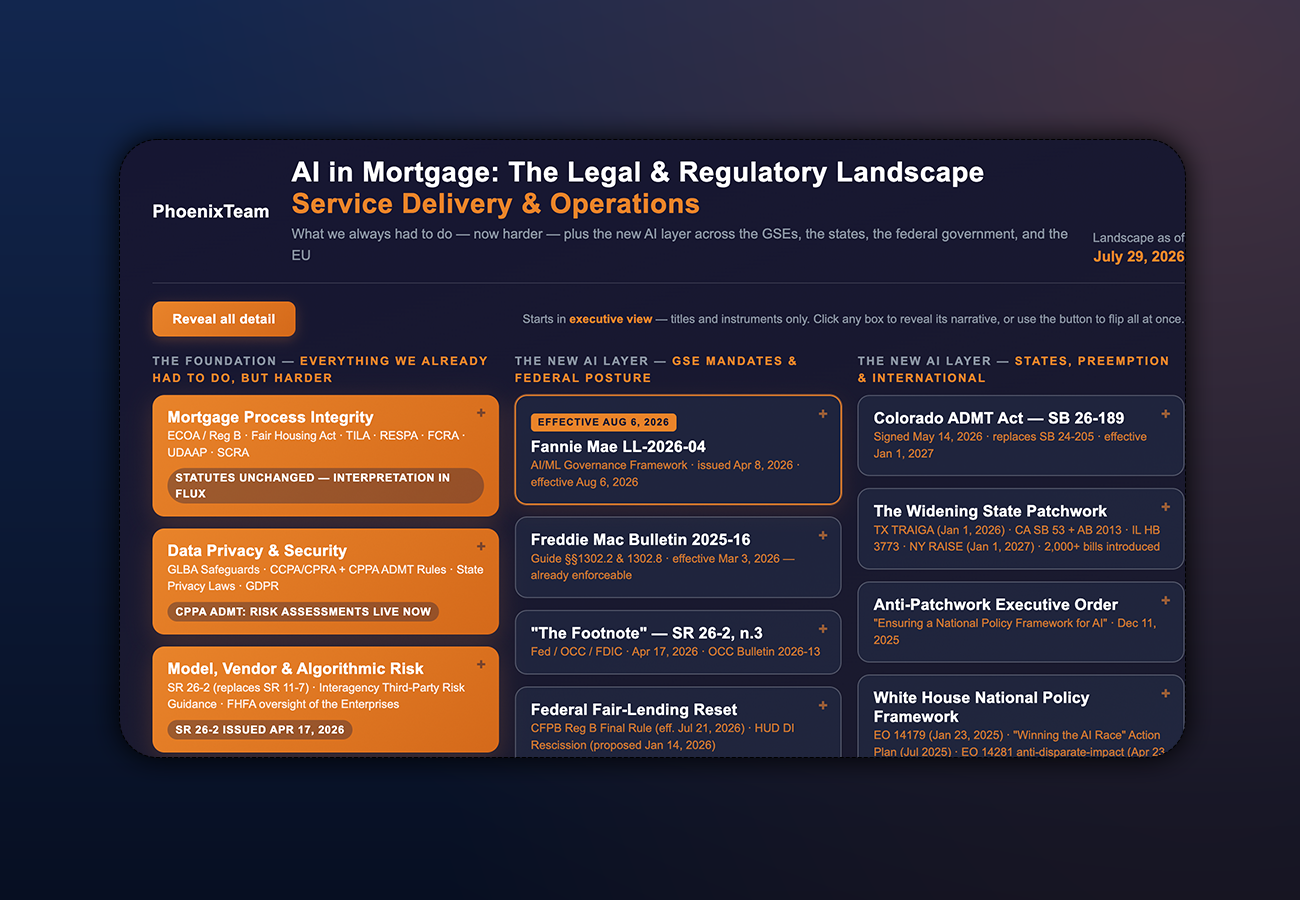
Artificial intelligence is adding another layer of complexity to an already highly regulated mortgage environment. Organizations must continue meeting established obligations related to fair lending, privacy, information security, model risk, vendor oversight, and consumer protection while also responding to new AI governance requirements emerging across the GSEs, federal agencies, states, and international markets.
The interactive landscape below brings these developments together in one view. Explore each section to see the key requirements, effective dates, and operational considerations mortgage leaders should be watching as of July 29, 2026. Although the requirements vary, they increasingly point to the same foundation: clear ownership, documented use cases, meaningful human oversight, ongoing testing, vendor accountability, and an audit trail that shows how AI is being used.
What we always had to do — now harder — plus the new AI layer across the GSEs, the states, the federal government, and the EU
Every AI-touched decision still carries adverse-action notices with specific reasons, disclosure timing, servicing rules, and anti-discrimination duties. The tech is new; the liability is not.
AI multiplies data flows. California's ADMT regulations add pre-use notice, opt-out, and access rights for automated "significant decisions" — phasing in April 1, 2027.
Model risk management got its first rewrite in 15 years — principles-based, tailored, and pointedly silent on GenAI. Vendor AI is your AI.
Principles-based mandate for all seller/servicers using AI/ML in origination or servicing: documented policies, annual owner review, vendor governance "no less protective," and disclosure to Fannie Mae on demand.
The prescriptive twin: detailed governance, audit, and security requirements for AI/ML systems, codified directly into the Seller/Servicer Guide.
GenAI and agentic AI are carved out of formal MRM scope as "novel and rapidly evolving" — yet institutions must still govern them under their own risk frameworks. The gray zone is the risk.
Disparate impact removed from Reg B; discouragement narrowed; SPCPs restricted. HUD proposes leaving Fair Housing Act effects claims to the courts.
Binds federal agencies — FHA, VA, USDA, Treasury, and FHFA itself (which filed its own compliance plan). The GSEs are not agencies, so it does not bind Fannie or Freddie directly; it reaches vendors only via M-25-22 procurement.
The bellwether, rewritten: duty-of-care and impact assessments out; pre-use notice, 30-day adverse-outcome explanations, human review, and 3-year records in. Critically, the old financial-institution exemption is gone — no GLBA carve-out for lenders.
Intent-based liability, frontier-model transparency, employment-AI discrimination rules (including zip-code proxies), and deepfake/provenance statutes — with NIST AI RMF alignment as a Texas safe harbor.
DOJ AI Litigation Task Force to challenge state AI laws; BEAD funding leverage; FCC/FTC preemption theories. Until courts rule, state laws remain enforceable — uncertainty, not relief.
Acceleration and deregulation as national policy — the through-line connecting the Reg B rewrite, HUD's proposal, and the preemption push.
Annex III high-risk obligations for credit scoring pushed out; but Article 50 transparency duties still largely land Aug 2, 2026.
Not guidance — contract. If you sell or service, you govern, document, and disclose on demand. Both Enterprises now require it.
Statutes, courts, states, and private plaintiffs remain — and rules can swing back. Build AI to survive the standard, not the administration.
The preemption fight creates litigation uncertainty, not a compliance holiday. State laws bind until a court says otherwise.
SR 26-2's Footnote 3 shifts the burden to your own framework. Examiners can still cite unsafe or unsound practices.
Inventory, documentation, human oversight, adverse-outcome explanation, vendor parity, audit trail. Build the spine once; comply many times.
Prepared by PhoenixTeam · All dates and instruments verified against primary and legal sources as of July 29, 2026 · Companion briefing contains full citations
ECOA · FHA · TILA · RESPA · FCRA · GLBA · SR 26-2 · LL-2026-04 · Bulletin 2025-16 · SB 26-189 · TRAIGA · M-25-21 · EU AI Act