


I’ve talked before about how managing regulatory change in mortgage is kind of like trolling the internet. Mortgage compliance requirements are primarily published in formats suitable for human readers, not machines. The requirements span hundreds of entities, including federal bodies, state attorneys general, investors, federal and local housing agencies, and the government sponsored enterprises (GSEs), with each providing requirements in diverse formats through multiple, inconsistent distribution channels. According to the National Mortgage News, this has created more than 1,000,000 pages of requirements overt time. Yikes.
How Mortgage Compliance Actually Works
We envision compliance as a wheel, with change at the center and evidence of process compliance as the enveloping outer ring. The change kicks off a cascading process that can take anywhere from 45 days to 18 months, depending on the size and complexity of the change.
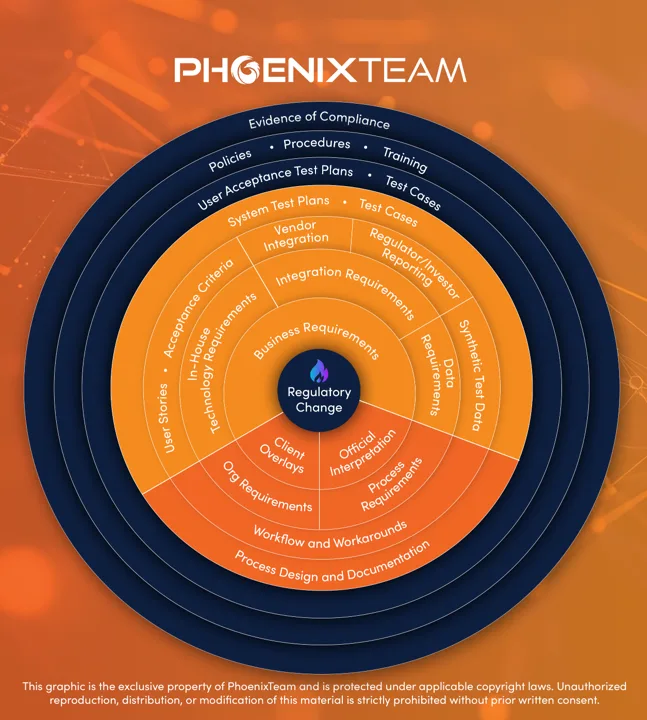
There is never time to test everything, and compliance and line of business operators ship around copies of an excel spreadsheet to analyze and communicate the requirements. Engineering teams create Jira and ServiceNow tickets to track the development work, and a testing team somewhere might test a subset of the change before production. Mortgage companies then rely on first, second, and third line of defense to actually provide evidence of process compliance at the enterprise and loan levels. There is an alternative to this insanity.
Definition: AI-ready data is structured, consistent, high-quality information that has been cleaned, properly formatted, and labeled to be immediately usable for training or analysis by artificial intelligence systems without requiring significant preprocessing or transformation.
The Alternative to Insanity: AI-Ready Policy Data
The emergence of generative AI (GenAI) in the mortgage industry present previously unattainable opportunities for automating compliance, risk assessments, and underwriting processes. However, AI systems require structured, standardized data to operate effectively. Current unstructured formats severely limit AI’s accuracy and usability. Our tests for Phoenix Burst have shown that structured regulatory data dramatically improves AI accuracy. We can achieve up to 79% accuracy using image-based formats contrasted with nearly 100% accuracy with structured inputs.

AI-ready mortgage policy data - structured in formats like XML or JSON - enables AI systems to easily access precise regulatory information, significantly enhancing operational efficiency, reducing compliance errors, and increasing the speed of implementing regulatory updates.
Benefits to Regulators and the Mortgage Industry
The people who make the requirements have both the authority and motivation to lead the shift to AI-ready data. Standardized, open data directly aligns with the missions of affordable homeownership, clarity, transparency, and effective oversight. It facilitates real-time compliance monitoring, improved market surveillance, and reduces reliance on costly third-party interpretations.

The industry is missing out on significant opportunities to dazzle customers and bring new innovation because we are focused on the bare minimum - compliance.
For the mortgage industry, structured data reduces costs, enhances compliance accuracy, and accelerates adoption of regulatory changes. Lenders can integrate real-time regulatory updates directly into automated systems, significantly cutting manual compliance efforts and improving overall lending efficiency.
Hosting AI-Ready Data: Addressing Jurisdictional and Privatization Challenges
It is an interesting thought experiment to consider who might host such a centralized data service. It is this author’s opinion that the information should quite obviously be democratized, so the cost of access should be negligible (the Federal Register application programming interface for example costs nothing to access). Yet there is a cost to create and manage such a service. There is a responsibility to be impartial and independent. Who should create and host this service?
1. National Archives and Records Administration (NARA): NARA is the official record keeper of the United States federal government. They are currently the custodian of the Federal Register API. I love that they already much of the plumbing, but it doesn’t make sense for states to publish here. Furthermore, if Fannie Mae and Freddie Mac are privatized, it doesn’t make sense for them either. So that probably won’t work.
2. Mortgage Industry Standards Maintenance Organization (MISMO): MISMO is a non-profit organization that develops, promotes, and maintains voluntary electronic commerce standards for the mortgage industry. This option offers the potential for industry-wide acceptance and technical expertise. MISMO is a volunteer-based organization that undertakes a lengthy, consensus-based process, which would be the default process here. Diverging opinions will make this hard to do.
3. Consortium Approach: A dedicated consortium could effectively bridge federal-state-private sector dynamics, ensuring broad participation and standardized governance. This could be an alternative in the event MISMO chooses not to participate, the problem will be one of funding. I have no doubt the industry wants this, but the reality is standing up the API and supporting has a cost. Of interest here is that the Federal Register API is well documented and open source.
4. Open-Source Community: Kind of similar to a consortium approach, but really working from the ground up instead of top down. An open-source community is a collaborative group of individuals and organizations who voluntarily come together to develop, maintain, support, or improve openly accessible software or projects. Members contribute their time, knowledge, and skills, guided by shared goals, values, and openness.
I'm intrigued by the idea of creating an open source community based on the existing open source materials for the Federal Register API.
Facing Headwinds: Overcoming Industry Resistance
Existing compliance data providers might resist open data, fearing revenue loss. However, AI-ready standards open new monetization avenues, such as advanced analytics, lower cost compliance validation services, and AI-driven tools built on top of structured data. Rather than competing on raw regulatory data, these companies can compete on sophisticated value-added offerings, growing their markets while improving industry compliance. Once the data is unlocked, an entirely new set of revenue opportunities will emerge.
States traditionally maintain independent mortgage regulations, posing a challenge to standardize. However, AI-ready data promises significant cost savings, streamlined compliance oversight, and improved accuracy in state-level enforcement. Demonstrating clear economic and operational benefits through pilot projects and leveraging existing cooperative models like the Nationwide Multistate Licensing System (NMLS) can effectively encourage state participation without compromising their regulatory autonomy.
The Call to Action
If you make or use mortgage compliance requirements, we really want to here from you. Please engage and tell us what you think. Transitioning mortgage policy data to an AI-ready standard is so much more than a technical problem, it’s a strategic solution that unlocks previously infeasible efficiencies.