

It's hard to create impact in a sea of slop. (Coined by tech journalist Casey Newton, AI slop is the term for the flood of low quality, AI generated content created rapidly to attract eyeballs and sell or promote things). One of the effects of this AI slop era is to diminish the value of online and offline content. What we see and read online is now subject to a new critical lens of "is this real?" and "was this generated by AI?". This effect is carrying over to offline content as well - if everyone is an expert, who and what can we rely on?
The Question
Last week we closed out the third AI exchange in our series on AI's impact on the workforce. One of the questions I wanted to answer was how to lead when digital is cheap and AI slop is everywhere. What's different about an AI-fluent leader? How do we find and amplify the things that matter for teams of humans and machines, working together? How do we help a group see clearly in a sea of bland and remixed messages?
Big caveat - I can only speak from a place of my own lived experience so this writing is from that perspective. Different leaders do different things and can be equally or more successful, I just offer my $0.02 for what it's worth.
Leadership
I went down a frustrating leadership rabbit hole last week preparing my opening remarks for the AI exchange. I figured I would find an quick and easy to lean on definition of leadership. After about 30 minutes I settled on the definition of leadership as helping a group to see clearly, choose a direction, and move together, while owning the consequences. Leadership is a quality a person can have, and thing a person or people can do, as well as a process.
AI-Fluent Leadership
Unlike genAI-native technology (which I'll shorten to AI-native for this article), we don't have truly "AI-native" leaders yet since the AI-natives are only about three years old right now. I'll define AI-fluent leadership as:
Helping a group see clearly when AI (and AI slop) is an integral part of everything we do, choose a direction that will be informed by both humans and machines, and move together with people that have widely variable levels of AI-fluency, all while owning the consequences of what humans and machines do.
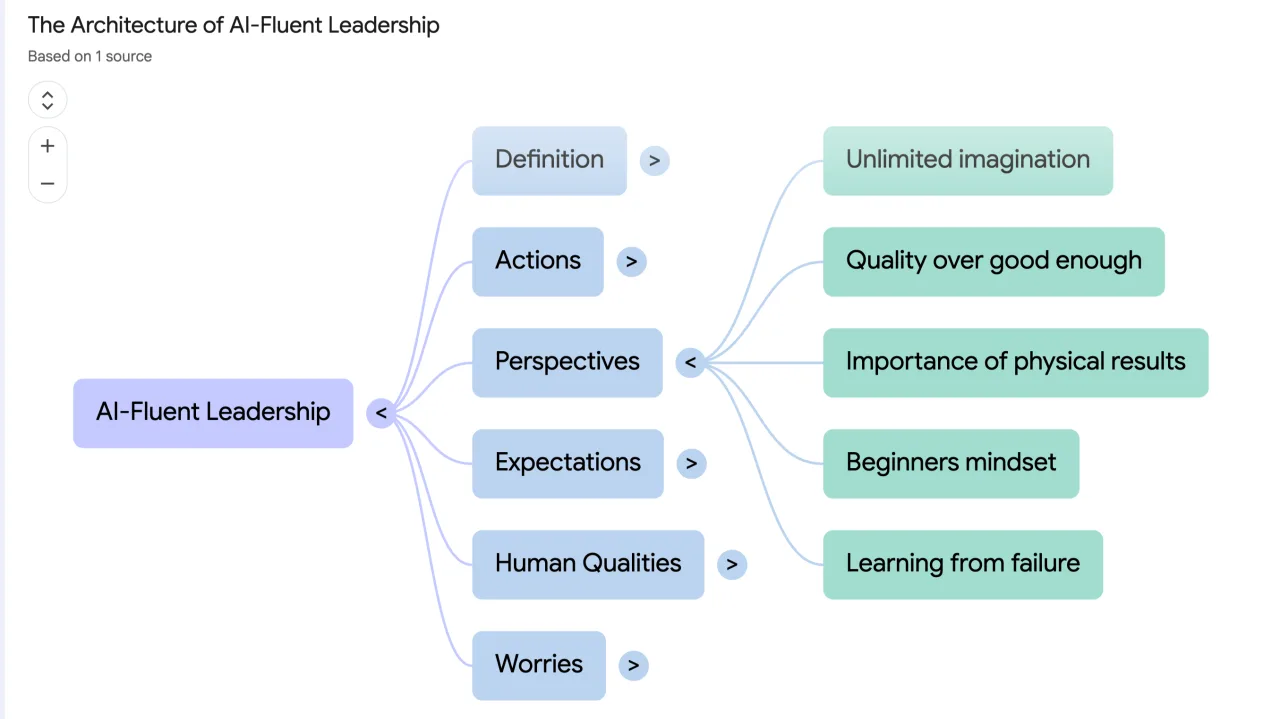
AI-Fluent Leadership Actions
I am, or am at least trying to be, an AI-fluent leader. Maybe not a good one, but that is the subject for another day. So what has changed about what I do? The first and most obvious change in my actions is that I use genAI all the time, every single day, constantly. I use it to create new things, accelerate my work, and amplify my creative impact. I have become supercharged, I can do all the things I used to be able to do at an even more vigorous level.
I also build things all the time. At least once a day I am in Claude Code building something new, or tweaking something I built already. I also use the things I build. Not all the things, sometimes I build things that turn out not to be useful, but this has been perhaps the most profound change in my way of working. Later in my career, especially in the last ten years or so, I became a pretty prolific creator. GenAI has now unlocked the inventor and individual builder in me.
For better or for worse - I write all my own content. And it's really time-consuming. I use writing to crystallize perspectives, consider alternatives, and to learn. Inevitably I have to research, pull threads, maybe try something new - that's just my process. I think it's important to have our unique voice, and have the voice come through. I don't even use genAI to edit, as I have come to believe the occasionally typo is a good thing, it shows I'm not a bot.
AI-Fluent Leadership Perspectives
I now believe that anything we can imagine, we can make. We can have an idea, and bring that idea to life in a day. The only limits are the limitations imposed by physical reality, and even that is changing with accelerated computing and embodied AI (think robotics). Even if I can't do it, could a robot do it? As Jensen says, when we take the effective cost of something to zero or approximately zero, previously unimaginable things become possible.
I also believe that quality matters way more than it used to, and this is because digital has become so cheap. Creating "good enough" is now trivial, which means "good enough" isn't good enough any more. It has to be great. A side effect of this is the important of offline results. Actual physical things. Yes the world has gone paperless, and I'm going paperfull. I'm like the salmon fighting the current. I want things to matter more, and I believe a part of that is taking the time and putting in the effort for a quality physical thing. I want to create feelings and memories that stands out.
My nine-year old daughter believes there are no mistakes in art, just happy accidents. This to me is an absolutely perfect manifestation of the beginners mindset, and I love it. I believe in happy accidents, there is always learning in failure, and sometimes failing is succeeding. Not always, but a lot of the time.
AI-Fluent Leadership Expectations
I expect more from myself as a leader and from my leaders. I expect us to be able to move faster. I expect us to be able to scale out quickly. It's probably not a realistic expectation, but I expect leaders to be able to move at something at least approximating the pace of genAI. We talk about being on genAI time - where a day is a week, a week is a month, and a month is a year. I expect us to move with that kind of intensity.
Ethan Mollick talks about the jagged frontier, and I expect AI-fluent leaders to push the jagged frontier all the time. One of the most frustrating challenges in this AI future is bumping up against that boundary - that thing that should be possible but just isn't. Even more frustrating is the fact that the impossible could become possible at any point, and so we have to keep trying. What is possible isn't settled - just give it a week.
This AI future is hard and it moves fast. I do expect all this to take time, which I realize it counter to my first point (but as I often say - two opposing things can be true at the same time). I expect that we are all works in process and we have to give ourselves grace. We have to give others grace as well. We have to keep trying and learning from those happy accidents.
AI-Fluent Qualities
Bob Sternfels, the global managing partner of McKinsey described three qualities that are required to succeed in the AI future. I'm not a huge McKinsey fan, but I did find his remarks insightful. He talks about what the models can't do and that these uniquely human characteristics are the differentiating qualities that have already increased in significance post mass availability of genAI. They were really good.
The first is aspiration, setting the right ambitions and getting others to believe. The second is judgement, being able to know what is right and what is wrong when there are no easy answers. And third, he describes true creativity as contrasted with statistical remixing.
AI-Fluent Leadership Worries
One of the most significant pitfalls of AI-fluent leadership is the risk of creating a two-tiered workforce. I don't have an answer here, and I'm not even sure I have the right questions. As a society, do we have an obligation to create pathways for workers who are not AI-fluent and do not intend to become AI-fluent? Is the answer to that question different for each of us as leaders in our organizations?
As a leader at my company and in my industry, for at least the next ten to 20 years, we will have these pathways. We have clients that are not AI-fluent, and really haven't started their journey. We have and will continue to meet them where they are. We also have clients that are trailblazing in the AI future. We have and will continue to meet them where they are as well. And for all clients, regardless of where they are on their AI journey, our goal is to deliver outcomes for them. That hasn't changed.
I worry about the entry level professional roles in my industry, and roles for people entering our workforce from non-traditional paths. We simply won't have the traditional starter jobs anymore. I turned 50 last weekend, and the entry level jobs from 25 years ago for people like me don't or won't exist anymore. I have four kids - ages eight, nine, 11, and 22. I believe that we need to both prepare them for the path as well as prepare the path for them. My job as a parent is to help them find their way, help them to be happy, kind, and financially independent (when possible). My job as an employer is to create entry level opportunities, even if it's a little fuzzy what those opportunities are.